| The
Mediterranean Sea
- a brief history Page 6 - |
The
Greeks
During the same period, various roaming tribes settled down in Greece, the Eoli in the north, the Ion in Athens, who were good navigators and the Dori, who settled in Pelopenesia and Sparta.
Their
homelands, consisting of mountainous territories and many islands, all
with very little arable, fertile land, encouraged them to seek more
suitable lands. In the east was the Asian Anatolia (Turkey) and in the
west was Southern Italy.
The
early settlers of the eastern lands, now Turkey, found a blessed territory,
innumerable sheltered bays only a few nautical miles from one another,
backed by fertile valleys with plentiful water. The favourable coastline
encouraged navigation and with it discovery, trade and conquests. It was
here that Greece majorly developed a highly advanced culture and
civilization.
Current
day Turkey, with its many ruins of passed glory is testimony and curator
of Western Civilation’s long and tormented history. See Pergamon,
Ephesos, Priene,
Miletus, Didyma
etc. In the early 19th century, a division was declared whereby the Greeks
had to abandon mainland Anatolia and the Turks to abandon the Aegean
islands, so that a clear separation was made between the two peoples.
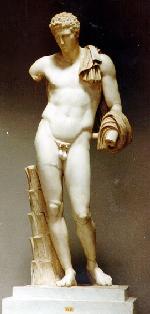
The Greeks’ achievements in war, colonisation, sport, democracy (see Pericles), architecture, sculpture (Phidias, Polykleitos, Lysippos, Praxiteles), mythology, astronomy, geography (Ptolemy), theatre (Sophocles, Aeschylus), philosophy (Socrates, Plato, Aristotle, Parmenides) and mathematics (Euchlid, Archimedes, Pythagoras), are well renowned and their writings substantially form the basis of all modern Western Thought.
The
Greeks hated the Persians and revelled in every occasion for a physical confrontation and
there are endless stories of battles and wars in their history. They colonised Sicily and
southern Italy, building magnificent temples at Paestum and Agrigento (also to be
visited), that rivalled the Acropolis in Athens itself.
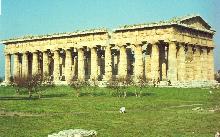 Paestum
  Agrigento
However, weakened by a war between Athens and Sparta, only 100 years later, Greece was overcome by its northern neighbours, the Macedons, whose ambitions went much further: the conquest of the whole known world! This great adventure, begun by king Philip and then brilliantly continued by his son, who was soon to become known as Alexander the Great, went on to conquer most of the then known world stretching from Greece, down to Egypt and over to Persia and as far away as India, all in a very short time. Only ten years elapsed from the conquest of Athens by Philip to Alexander the Great's death in 323 BC.
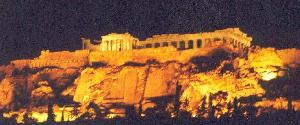 The Acropolis
During the Renaissance period, Europeans
rediscovered the arts of the Romans and of the Greeks and in time Greek architecture was
spread to many new nations, so that today, with its Doric and Ionic columns, Greek
architecture dominates government buildings right around the world.
The Mediterranean Sea
mediterranean-yachting.com
Copyright L. Camillo
2011